Wednesday, March 14, 2012

Foulard Bias Loop Scarf


Pattern/Instructions: Mohair Bias Loop
Yarn/Fil: Louet Merlin 60% linen/lin 40% merino wool/laine mérinos
Time require/Temps requis: I think a couple of weeks/Environ une semaine je crois

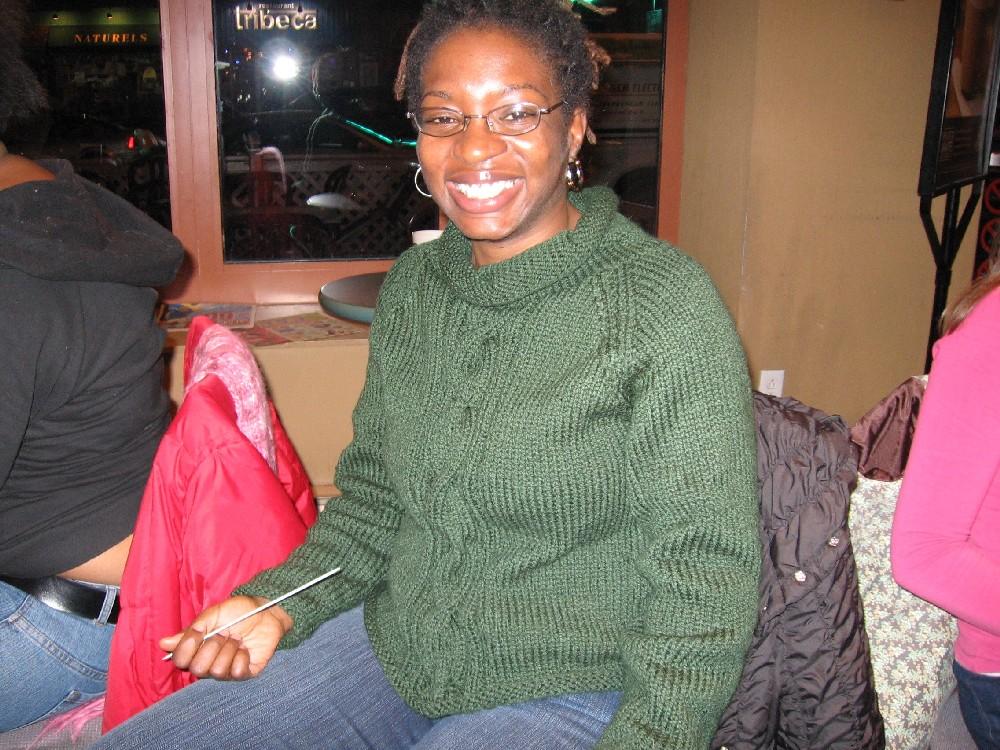
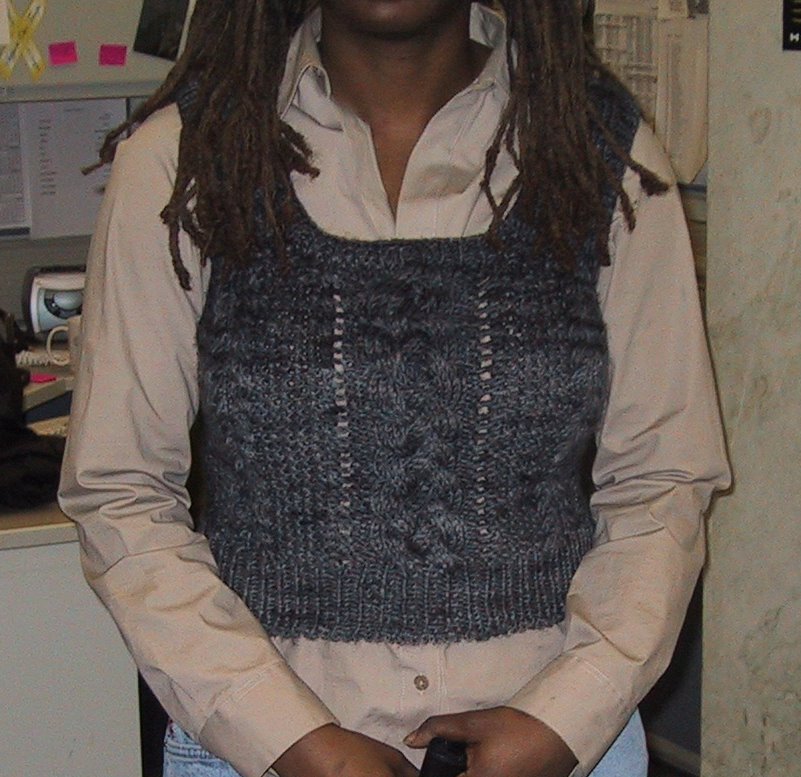
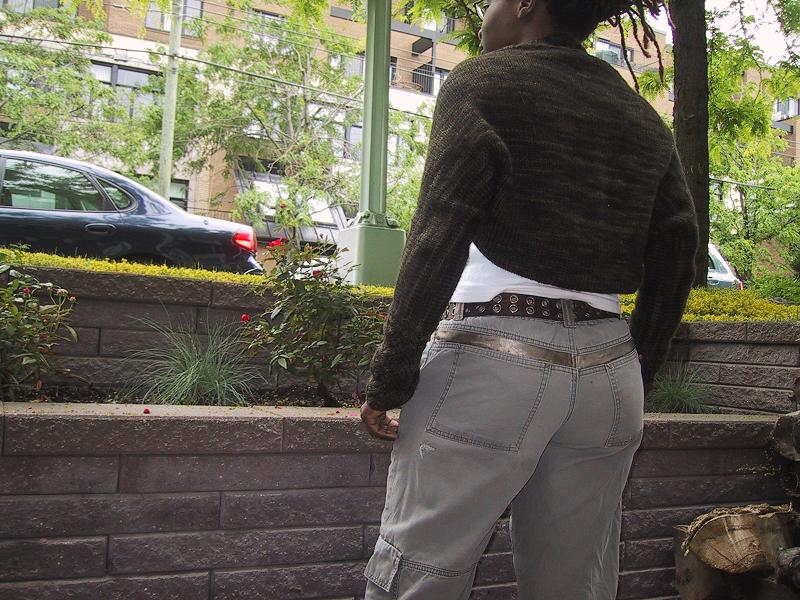
A couple months ago, my baby sister asked where I could find patterns for eternity scarves for her mom to knit her.  Going through Ravelry I found the pattern for this scarf an, of course, I loved it. By looking at pics I figured out it construction and dimensions. By snooping on project notes I got the rest of the info I needed. This will definitely be a staple in my wardrobe this summer. and yes it was cold the day I took this pic.

I will very likely revisit this yarn again, I've finally overcome my phobia of knitted summer tops and there's a couple of Ts I'd like to make.

Il y a quelques mois, ma petite sœur m'a demandé de lui trouver des instructions pour un foulard en boucle pour que ma belle-mère lui en fasse un. En fouillant sur Ravelry, je suit tombée sur celui-ci et l'ai aimé aussitôt. J'ai pu en deviné la construction  et dimensions en regardant les photos de projets terminés et en ai trouvé le reste de l'info en fouillant dans les notes. Ce foulard fera parti de mes basiques cet été. Et oui il faisait froid lorsque j'ai pris cette photo.

Je réutiliserai très probablement ce fil bientôt. J'ai finalement surmonté ma phobie des tricots estivaux et il y a des T-shirts que je voudrais bien faire.

Labels: , , ,

Sunday, March 11, 2012

Butter/Beurre

The other day I was watching a cooking show in which it was demonstrated how to churn butter. It looked so easy that I had to try it for myself. Thanks to Google, YouTube and after a huge mess in my kitchen, I figured out how to make made butter with my small hand mixer. I used a 40% organic cream that I picked up at my local farmer's market.

L'autre jour j'écoutais une émission de cuisine où on montrait comment faire du beurre. Ça avait l'air si facile que je me suis dit que je devais essayé ça. Grâce à Google, YouTube et une cuisine remplie de vaisselle sale, j'ai fini par trouvé comment faire avec mon petit batteur. J'ai utilisé de la crème 40 % et organique trouvé au marché.

First I thought of making this in an old spaghetti sauce container I had. But, once I realized that my hand mixer was set too low,  I cranked it up to mid speed and I switched to a regular whip attachment so thee cream started to thicken and threatened to spill out.

J'ai d'abord commencé à le faire dans une bouteille de sauce à spaghetti. Réalisant que la vitesse de mon mélangeur était trop basse,  je l'ai augmentée à une vitesse moyenne et que j'ai changé le fouet, la crème à pris du volume, et menaçait de déborder.

So I poured it into a regular sized bowl where it really did it's thing. The point is to overwhip the cream until the fat separates front the liquid but this was proving to be a challenge for tiny mixer, it killed the motor a few times. I then tried to whip it in my blender but again the cream was too thick for it, it could only work on the portion that was directly touching the blades. 

J'ai donc versé la crème dans un grand bol à mélanger où la magie a opéré. Le but de la procédure est de surfouetter la crème au point que le gras se sépare du liquide mais ceci se révélait trop ardu pour mon petit batteur. J'ai ensuite essayé d'utiliser mon mélangeur (blender) mais la crème était trop épaisse, il ne pouvait que travailler sur la portion qui touchait les lames.


Just as I was thinking that all was lost I had an A-Ha moment: what if I whipped smaller batches at a time, maybe my hand mixer could handle that. Sure enough, within seconds of doing that the magic happened: Separation! I strained the butter from the liquid aka buttermilk.

Au moment de perdre espoir j'ai un Eurêka!: Et si je ne travaillait qu'une petite portion de la crème à la fois, mon batteur serait sûrement assez puissant pour être efficace. Sitôt pensé, sitôt fait, et en quelque seconde la magie a opéré et la séparation tant attendu a eu lieu. J'ai versé le beurre dans une passoire afin de séparer le beurre du babeurre.


Then I rinsed the butter to wash off the leftover butter milk.

Ensuite j'ai rincé le beurre pour éliminer toute trace de babeurre.

I used my spatula to mold the butter, that action also squeezed out the excess rinse water that I simply poured out. While I was doing that I added 1/2 teaspoon of salt to have salted butter, a full teaspoon looked like too much and cutting back was the right thing to do.

J'ai moulé le beurre avec une spatule, ce qui a aussi permis de sortir l'excédent de l'eau de rinçage que j'ai tout simplement jeté et j'en ai profité pour ajouter une demi cuillerée à thé de sel. J'ai d'abord pensé en mettre une cuillerée complète mais j'ai préféré me retenir et au bout du compte, ce fut la bonne décision.


And here's the final result. 500ml/2 cups of cream yielded 150g/5.3 ounces of butter or about 250ml/1 cup. I also have 200 ml/3/4 cup of butter milk. I'd probably have a little more if I hadn't transfered the cream from container to container. Will I make this again? Very likely since it's a fun thing to do and it's a great way of using up leftover cream. Next time I will start the process using my larger bowl and then finish smaller portions in a smaller container in order to maximize the capacity of my small hand mixer.

Et voici le produit final: 500 ml de crème a donné 150g ou environ 250 ml de beurre en plus de 200 ml de babeurre. J'en aurais probablement obtenu un peu plus si je n'avais pas transféré la crème de contenant en contenant plusieurs fois. Vais-je refaire cette recette? Certainement, c'est assez facile et amusant à faire, en plus que c'est une bonne façon d'utiliser de la crème excédente d'une recette.  La prochaine fois, je commencerai le processus dans un grand bol et ensuite, lorsque mon petit batteur ne suffira plus à la tâche, je continuerai en travaillant de petites portions à la fois afin de maximiser l'efficacité de mon petit batteur.

Labels: , , ,

Sunday, March 04, 2012

Toque!

 Français plus bas


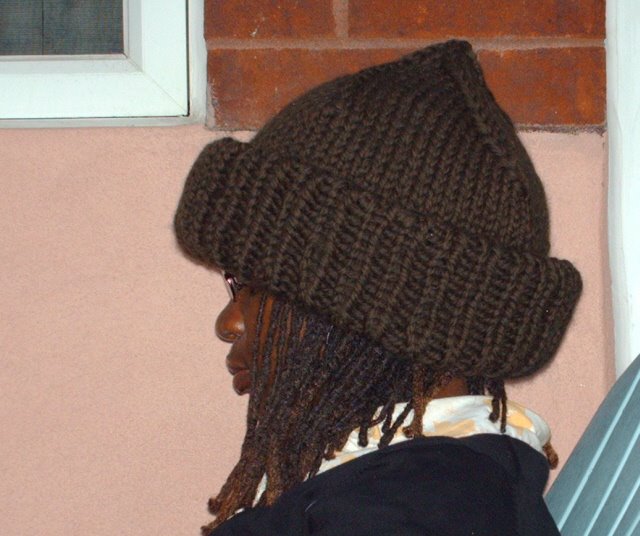
My love for knitwear done with basic stitches continues. Here's a hat to replace my last Sea Urchin II. At this point it's fair to say that my winter accessories are destined to be forgotten on a metro bench. 

For this project, I wanted a simple hat with a deep cuff. I don't know where the idea of making it with a garter st came from but combining it with a 1x1 rib has given a great result. 

I wasn't planning on making a pattern but I figured there must be someone out there with a big head and big hair for whom what's available is usually too small. That is why I didn't provide instructions for smaller sizes. 

The hat measures 55 cm/22" and my head, dreads included, measures 63 cm/25". It is also made from the top down.
Yarn

1 skein Cascade Yarns Eco+ (I used about half of it so about 220 m/239 yards of bulky weight yarn)

Materials

1 set of 4 double pointed needles 

1 40 cm/16" circular needle 5.5mm (or longer like I did but using the magic loop technique)

7 stitch markers plus 1 more in a contrasting colour to mark the beginning of the round

1 tapestry needle

Gauge

19 sts = 10 cm/4" in stockinette stitch
Abbreviations :

** : Repeat the instructions between the asterisks until the end of the round

DPN : Double pointed needle

K: Knit

K1fb : Knit in front and back of the stitch

M1 : Make one stitch knitwise

P: Purl

St : Stitch

1X1 rib : K1, P1

Note 

You will begin making this hat with the DPNs. You decide when you want to start working with the circular needle

Instructions

Using the Eastern (aka Turkish) cast on method and the DPNs, cast on 8 stitch. Place the st marker to mark the beginning of the round, knit one round, purl the next one. Next round, k1fb on each st, you now have 16 sts Distribute the sts evenly over four DPNs. Purl the next round. Continue with the increases as fallows :

Round 1 : *K2, place a stitch marker*

R2  : Purl

R3 : *K until the st marker, M1, slip the st marker*

R4 : Purl

Repeat R3 and 4 until you have a total of 104 sts, remove the st markers except the one that marks the beginning of the round. Then continue working alternating k and purl rows until the hat measures 16cm/5" from the beginning (or you can try it on as you go, when you're about an inch from your eyebrows, start the rib). You will notice a "seam" along the hat, that is where you've switched sts.

Continue in a 1X1 rib until hat measures 11" from the beginning. Again you can try it on with the cuff folded and stop knitting when you like the length. The rib is meant to start for about an inch/2.5 cm inside the hat before folding out, with the fold on thhe eyebrows (for those deep winter cold snaps)

For the bind off you can either do a sewn bind off (I have a link in my How To menu) or you can do the surprisingly stretchy bind off. Weave in the threads.


Mon intérêt pour les projets tricot fait avec des points simples ne s'amenuise pas. Voici un nouveau chapeau pour remplacer mon Oursin de Mer II. Il ne me fait maintenant aucun doute que mes accessoire d'hiver sont destinés à être oubliés sur un banc de métro.

Pour ce projet, je voulais une simple tuque avec un revers assez large.  Je ne sais pas d'où m'est venu l'idée d'utiliser un point mousse mais en le combinant avec une côte simple, cela donne un beau résultat.

Je n'avais pas l'intention d'en écrire les instructions mais je me dis qu'il doit bien avoir quelqu'un avec une grosse tête et/ou beaucoup de cheveux pour qui qui les chapeaux sur le marché sont toujours trop petit. C'est la raison pour laquelle je ne donne pas les instructions pour de plus petites dimension. 

Ce chapeau mesure 55 cm alors que ma tête, cheveux inclus, mesure 63 cm.

Fil

1 écheveau de Cascade Yarns Eco+ ou environ 220 m de gros fil

Matériel

1 ensemble de 5 aiguilles à double pointes

1 aiguille circulaire de 40 cm de long – 5.5mm (ou une aiguille plus longue mais vous devrez utiliser la technique du magic loop)

1 aiguille à tapisserie

7 marqueurs plus une autre de couleur contrastante pour marquer le début de la rangée.

Échantillon

19 mailles = 10 cm en point jersey

Abréviation

** : Répétez les instructions entre les astérisques jusqu'à la fin de la rangée

F1E : Faire une maille endroit

M end : Maille endroit

M env : Maille envers

Note

Vous commencerez avec les aiguilles à double pointe et décidez pour vous-même quand changer pour l'aiguille circulaire.

Instructions

Avec la méthode de montage de mailles à la turque, montez 8 mailles. Placez le marqueur qui indique le début de la rangée et travaillez une rangée à l'endroit, la suivante à l'envers. Ensuite,  faites une maille à l'avant et l'endos de chaque maille. Vous avez maintenant 16 mailles, distribuez les de façon égale sur quatre aiguilles à double pointes. Travaillez la rangée suivante à l'envers. Ensuite :

Rangée 1 : *2 M end, placez un marqueur*

R2 : Travaillez à l'envers

R3 : *Faites des M end jusqu'au marqueur, F1E, glisser le marqueur*

R4 : Travaillez à l'envers

Répétez R3 et 4 jusqu'à ce que vous ayez 104 mailles. Continuez ensuite en alternant une rangée à l'endroit et une rangée à l'envers jusqu'à ce que le chapeau mesure 16 cm du début (ou vous pouvez toujours l'essayer pour vous assurez qu'il est de la bonne longueur, commencez à faire la cote lorsque le il vous arrive a 2.5 cm des sourcils).

Ensuite, faire une côte simple en alternant une M end et une M env. Continuez ainsi jusqu'à ce que le chapeau fasse 27.5 cm du début ou encore, vous pouvez essayer le chapeau en repliant le revers pour vous assurer de la longueur. Le revers est commence à 2.5 cm à l'intérieur du chapeau avant de replier vers l'extérieur, le pli se trouvant au niveau des sourcils (pour ces jours de froid intense).

Pour rabattre les mailles, vous pouvez faire soit un rabat cousu ou encore faire la méthode suivante. L'avantage de cette méthode est que vous n'avez pas à vous soucier de la quantité de fil nécessaire:

Travaillez la maille telle qu'elle se présente (ie à l'endroit ou l'envers). Faites une jetée. Travaillez la maille suivante et rabattez la jetée sur celle-ci. Ensuite rabattez la première maille sur l'aiguille de gauche sur la seconde comme pour un rabat normal. Continuez à faire les jetées entre chaque maille et les rabats jusqu'à la fin.

À l'aide de l'aiguille à tapisserie, rentrez les fils au travers des mailles.

Labels: , , , , ,

Sunday, January 29, 2012

Shoe Rack/Support à Soulier


Instructions: Picture Rail Shoe Rack by/par Martha Stewart Living
Material/Matériel: L shaped molding/Moulure en L
Time required/Temps requis: About an hour/Environ une heure
Modifications: I used an L shaped moulding/J'ai utilisé une moulure en L

I have been on a home clean up tear lately, courtesy of me accidentally finding an online homekeeping guru who's methods seem to finally work for me. It could also be that, like an alcoholic who comes across an AA meeting when she's finally ready to quit, I have finally decided once and for all that a clean, well organized home is worth the time and effort required and found a resource to help me get there at the right moment.

All that cleaning seems to have triggered my other passion that was dormant for a minute: Home decor.  I've been spending time at that time suck that is Apartment Therapy where I came across this shoe rail project by Martha Stewart Living. And just in time too because I had just finished cleaning up my bedroom and had my shoes lined outside of my closet and I hated the way they looked but I had no room in the closet to store them. So, I ran to the reno store, got an 8 foot long moulding (couldn't find the picture rail moulding specified in the instructions), cut it to size, nailed it up and voilà! Once again I am so happy to have a well stocked tool box so I only spent 8$ on for this. I have room for one more pair of shoes  that I could hang on the wall and after that, I'll have to be willing to part with a pair I currently own if I want to get a new one.


Je suis devenue une maniaque des tâches domestiques depuis qui je suis tombée par hasard sur une gourou du ménage dont les méthodes semblent fonctionner pour moi. Soi ça ou telle une alcolo qui serait tombée sur une rencontre des AA au moment qu'elle se serait décidé de d'arrêter de boire, j'ai peut-être enfin compris qu'une maison bien maintenue vaut bien l'effort requis et j'ai trouvé la bonne ressource au bon moment.

Ceci étant dit, tout ce frottage au torchon semble avoir réveillé une passion qui s'était assoupie: la déco. Ce qui veut dire que j'ai perdu pas mal de temps chez Apartment Therapy où j'ai trouvé ce projet par Martha Stewart Living. Et c'était vraiment une trouvaille opportune car je venais de mettre de l'ordre dans ma chambre et voulait remettre mes souliers dans ma garder-robe. J'ai donc été faire un tour au centre de rénovation et y ai acheté une moulure en L longue de 8 pieds (je n'ai pu trouver la moulure spécifiée dans les instructions). Je les ai coupé en morceaux de 2 pieds, ai cloué les morceaux au mur et voilà! Une fois de plus je suis contente d'avoir un coffre à outil bien rempli, ce projet ne m'a couté que 8$. J'ai de la place pour accrocher une autre paire de soulier et après ça, je devrai me départir d'une paire que je possède si j'en ramène une autre à la maison.

Labels: , , , , ,

Sunday, January 22, 2012

Vogue V8778


Pattern/Patron: Vogue V877
Fabric/Tissue: Main/Principal: Leopard print fleece/Molleton imprimé léopard; Contrast/Contraste: ribbed knit/Tricot côtelé
Time required/Temps requis: About 6-7 hours/Environ 6-7 heures
Modifications: See below/Voir texte

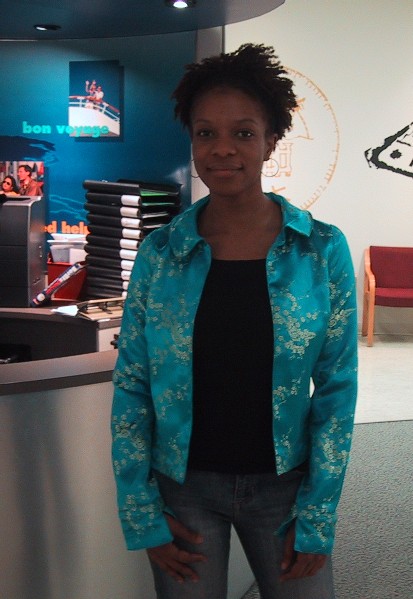
A quickie project, I knew that no FBA would be required but I figured I was surprised to say that I didn't have to modify the pattern for my hips and bum since there was more then enough ease. I did make a couple modifications: I added a snap button at the collar because I liked the overlap seen in pattern's Model A. But the most elaborate change was at the sleeve. If you look at the pattern's envelope you see that the contrasting part of the sleeve is simply sewn onto the the fleece. I thought that looked sloppy, not to mention that it defeats the idea that you're supposed to think that your wearing a short sleeve fleece jacket over a long sleeve top. So I added 3/8" to the seams, folded the sleeve along the seam line to form a hem, then topstitched the hem onto the contrast portion together. I bit (that's borrow for you non urban speakers LOL) that fleece idea from Erica B's coat. 
PS: that's not dandruff on my hair, only flurries.

Petit projet rapide. Je savais qu'aucun ajustement pour poitrine forte n'aurait été nécessaire mais j'ai été surprise de me rendre qu'il y avait assez d'aisance dans l'ourlet pour qu'aucun ajustement n'y serait non plus nécessaire. J'y ai tout de même fait deux modifications. D'abord, j'ai rajouté un bouton pression à l'encolure pour simuler le look du col que l'on voit dans le modèle A du patron. Ensuite, je n'aimais pas la façon que la portion contrastante du manche était cousu sur le molleton, ça ne donnait pas assez l'illusion que l'on portait un veston à manches courtes sur des manches contrastantes et donc j'ai rajouté 1cm à la couture et replié la couture du manche comme un ourlet et l'ai surpiqué sur la manche contrastante. Quand au choix du motif, j'ai été influencé par le manteau d'Erica B. Et non ce ne sont pas des pellicules sur mes cheveux mais des mini flocons de neige.

Friday, January 06, 2012

Châle Ashby Shawl


Pattern/Patron: Ashby by/par Leila Raabe
Yarn/Fil: Diamond Yarn Galway Heathers (4 skeins/écheveau)/Cascade 220 Heathers (1 skein/écheveau)
Time required/Temps requis: Two months/ Deux mois
Modification: See text/Voir le texte

Last September, I took my Mara shawl with me to Europe and and my mom threatened to just take it from me. I had already planned on knitting something for her for Christmas so I figured I'd just make one for her. But then Brooklyn Tweed came out with his pattern booklet and I figured that rather then repeat Mara, I'd make this one instead. The stripes are because I realized I was going to run out of the deeper Galway so I used a paler skein of Cascade 220, I couldn't find a better matter match, I alternated each colour at every repeat of the stitch patter.

En Septembre dernier, j'ai été en Europe avec mon châle Mara et ma mère a menacé de m'en soulager. J'avais déjà lui en faire un. Mais lorsque Brooklyn Tween a publié un livret de projets tricot, j'ai préféré faire celui-ci. Ayant réalisé que j'allais manquer de fil, j'ai utilisé un vert plus pâle car je n'ai pu trouvé une couleur identique. J'ai alterné les couleurs à chaque répétition du motif.

Labels: , , ,

Thursday, December 29, 2011

Couverture d''Inspiration Hudson Bay Inspired Blanket


Yarn/Fil: Berroco Vintage 50% Acrylic/Acrylique, 40% Wool/Laine,10% Nylon
Time required/Temps requis:  A couple of months/Presque deux mois
Modifications: I made the blanket longer in order to be proportional to the unintentional added width/J'ai fait la couverture afin d'en garder les mensurations proportionnelles par rapport à la largeur

I had chosen another pattern, my second choice at that point, to make a baby blanket for my sister who had her baby yesterday. But as soon as I saw this on Purl Soho's blog I knew I'd make this one. And once I started making the stripes I immediately regretted having to give it away LOL. I loved making this, garter stitch all the way making this an ideal pattern for TV watching. My choice of colours wasn't as bright as the original but that's because the LYS didn't have a bright red so even though I stayed with the traditional colours of a Hudson Bay blanket, I chose earthy versions of them. As usual the blue doesn't show up accuretly but even looking at the blanket itself you'd probably mistake it for a black. I chose an off white for the background. 

I accidentely made this with a US 8 sized needle and that may have led to the blanket being 5" wider then the finished size indicated. So to keep it in the same proportions as the original's measurements, I made the middle white section 4" longer. Other then that, no change has been made to the instructions given. But with it being larger it's more an Afghan now so my guess is she'll be using this herself. Because this is a crib blanket I made it with an acrylic/wool mix yarn to  make it's washing easier for my sister who now has two kids. In any case, I have enough of the coloured yarn to make another one for myself, in fact I have an extra skein of white since I only needed five for this blanket.


J'avais choisi un autre modèle, mon second choix à ce moment-là, pour faire une couverte de bébé pour ma soeur qui a accouché hier. Mais aussitôt que j'ai vu ce modèle-ci sur le blog de Purl Soho j'ai su que j'allais le faire. Et une fois que j'ai commencé à en faire les rayures, j'ai regretté ne pas pouvoir le garder. J'ai adoré faire cette couverte, le fait qu'il soit entièrement travaillé au point mousse en faisait le projet idéal à faire en regardant la télé. Étant donné que mon magasin de tricot n'avait pas un rouge vif, j'en ai donc choisi une version atténuée et ai choisé le ton des autres couleurs en conséquence. Même en réel, le bleu paraît noir. J'ai aussi choisi un blanc cassé pour l'a couleur d'arrière-plan.

Sans faire exprès, j'ai utilisé une aiguille de 5mm, ce qui a peut-être donné comme résultat que la couverte est plus large de 12.5 cm par rapport à l'original. Pour en garder les proportions, j'ai fait la bande blanche du milieu plus longue de 10 cm. Mais on ne plus vraiment l'appeller une couverte de bébé, c'est plutôt une jettée maintenant. J'ai choisi de travailler avec un fil fait de mélange acrylique et laine afin d'en faciliter l'entretien par ma soeur qui a maintenant duex enfants. Il m'en reste assez de fil de couleur pour me faire une autre couverte, il me reste aussi un écheveau dans le blanc vu que je n'en ai eu besoin que de cinq.

Labels: , , , ,